
Types of Sinks - Choosing the Right Sink for Your Home
Posted by Sinks on 4th May 2026
A sink is one of those things you don't think much about — until you're living with the wrong one. It’s too small, the wrong material, awkward to clean, or doesn't suit the worktop. It's a small everyday frustration that adds up fast.
The good news? Getting it right isn't complicated once you know what to look for. Whether you're renovating your kitchen, refreshing your bathroom, or starting from scratch, this guide walks you through everything — the different types of sinks available, how to choose the right one, and what works best in a kitchen versus a bathroom. Let's make this easy!
Types of Sinks — Know Your Options
When people talk about the different types of sinks, they usually mean one of two things: the material the sink is made from, or the way it's fitted into the worktop. Both matter, and understanding the difference is the first step to making the right choice.
At a Glance: All Sink Types Compared
|
Sink Type |
Material / Style |
Best For |
Maintenance |
Style Fit |
|
Material |
Busy kitchens, everyday use |
Very Low |
Modern, any style |
|
|
Material |
Traditional & classic kitchens |
Low |
Heritage, country |
|
|
Material |
Premium & contemporary kitchens |
Low |
Luxury, modern |
|
|
Fitting Style |
Stone/quartz worktops |
Very Low |
Sleek, seamless |
|
|
Fitting Style |
Any worktop, retrofits |
Low |
Versatile, classic |
Types of Sinks with Sinks.co.uk
1. Stainless Steel Sinks
Stainless steel is the world's most popular sink material — and it's earned that reputation. It's tough, hygienic, heat-resistant, and genuinely versatile. It works in minimalist kitchens, classic kitchens, and everything in between.
What makes it a favourite is how little effort it takes to maintain. All it needs is a quick wipe down, and it looks good as new again. It doesn't hold onto stains or bacteria, it handles boiling water without a second thought, and it comes in a wide range of sizes and configurations to suit almost any layout.
If you want a reliable, no-fuss sink that will serve you well for years, stainless steel is a brilliant starting point.
2. Ceramic Sinks
There's a warmth and solidity to a ceramic sink that's hard to replicate. That smooth, glazed finish — usually in classic white or cream — brings a timeless quality to a kitchen or bathroom that many people find hard to walk away from.
Ceramic is naturally hygienic, easy to wipe clean, and impressively scratch-resistant for everyday use. It is heavier than stainless steel, so your cabinetry needs to be up to the job — but once it's in, it's in. A well-chosen ceramic sink can anchor the kitchen's overall look and last for decades.
It's the go-to choice for traditional, country-style, and heritage kitchen designs—and it's just as at home in a classic bathroom.
3. Granite Sinks
Granite composite sinks are made from a blend of real granite stone dust and resin — giving you the look and feel of natural stone with the practicality of a modern sink. They're heavier and more substantial than stainless steel, available in rich, earthy tones like matte black, slate grey, and warm sand, and they bring an undeniable sense of quality to the spaces they sit in.
Performance-wise, granite composite sinks are exceptional. It's highly resistant to heat and scratching, and holds its colour and finish beautifully over time. If you're investing in a kitchen and want a sink that complements the look rather than just serving a function, this is the material to consider.
Types of Sinks by Fitting Style
1. Undermount Sinks
An undermount sink is fitted beneath the worktop, so there's no visible rim breaking the surface — just a clean, seamless transition from countertop to basin. It's a modern, practical choice that looks as good as it performs.
Because there's no lip or rim sitting on the worktop, there's nowhere for water, crumbs, or grime to collect. Cleaning is effortless — you wipe straight from the surface into the bowl. It works particularly well with stone, quartz, and solid surface worktops, where the flush finish really comes into its own.
Undermount sinks come in three bowl configurations:
- Single Bowl — One large, open basin. Great for households that cook big meals and need the space to wash oversized pots and pans without playing Tetris.
- Single & Half Bowl (1.5 Bowl) — A full-sized main bowl paired with a smaller secondary bowl. The most popular configuration for good reason — it lets you multitask naturally, draining on one side while prepping or washing on the other.
- Double Bowl — Two equal basins side by side. Ideal if you like clear separation between tasks — washing on one side, rinsing on the other.
2. Inset Sinks
Inset sinks — sometimes called top-mount or drop-in sinks — sit on top of the worktop, with the rim resting on the surface. They're the most traditional-fitting style and one of the most versatile. They're compatible with virtually any worktop material — laminate, wood, tile, or stone — and they're straightforward to install and replace.
The rim sits flush with the worktop surface, which means it needs a regular wipe-down to keep the edges clean. But it's a small trade-off for the flexibility they offer, especially in kitchens with laminate or timber worktops where undermounting isn't always possible.
Inset sinks are also a smart choice for renovation or replacement projects — they cause less disruption, are compatible with existing cabinetry, and are available in a wide variety of materials and sizes.
Just like undermount sinks, inset sinks come in three bowl configurations — so you're not limited in how you set up your sink space:
- Single Bowl Inset Sink — A wide, open basin that gives you full, uninterrupted space for washing up. This style is perfect if you want simplicity and the freedom to work.
- Single & Half Bowl (1.5 Bowl) — The classic combination of a main bowl and a smaller secondary bowl. Versatile, practical, and the most popular choice for everyday kitchens.
- Double Bowl — Two equal basins for those who prefer a defined system — one side for washing, one for rinsing or draining. A great option if you hand-wash frequently or like clear task separation.
How to Choose the Right Sink
Before jumping straight to a product, it's worth stepping back to consider four things. Getting these right makes the choice much simpler.
- Your worktop material is often the deciding factor for fitting style. Stone, quartz, and solid surface worktops pair beautifully with undermount sinks. Laminate and wood worktops are better suited to an inset. It's not a rigid rule, but it's practical.
- How you actually use your kitchen shapes the bowl configuration. Do you cook large meals regularly and need room to move? A single bowl gives you that freedom. Do you find yourself juggling multiple tasks at once — washing, draining, prepping? A 1.5 or double bowl will serve you far better day to day.
- The look you're going for matters more than people admit. A matte black granite sink in a modern kitchen feels intentional and considered. A ceramic sink in a country kitchen feels like it belongs. Your sink doesn't have to disappear into the background — it can be part of the design.
- Your budget will guide you toward a material, but don't let it be the only factor. A quality stainless steel sink at a sensible price point will outperform a cheaper granite option every time. Invest in quality within your range rather than stretching into a material you're not confident in.
Best Types of Sinks for the Kitchen
The kitchen sink is the hardest-working fixture in your home. It deals with boiling water, heavy pots, food waste, daily scrubbing, and everything in between — so choosing the right kitchen sink type genuinely matters.
Best Kitchen Sink by Material
For most kitchens, the choice comes down to three materials — and each has a clear sweet spot.
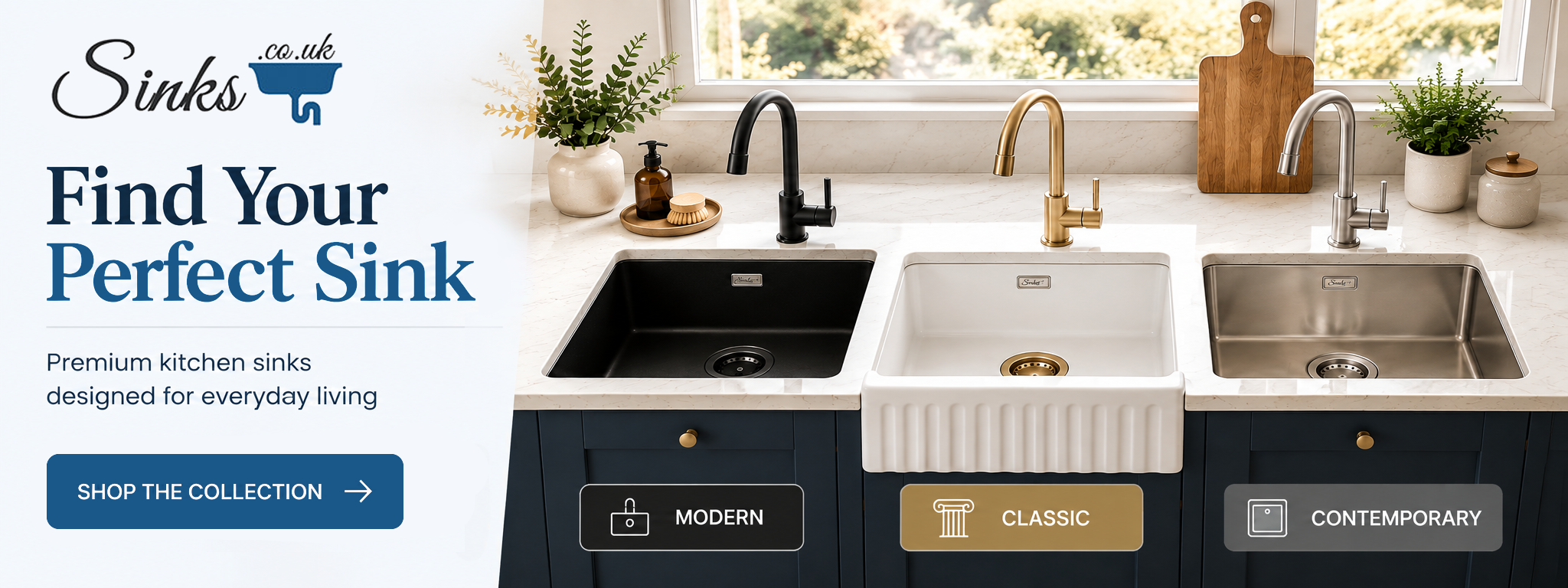
- Stainless steel is the most practical choice for a busy kitchen. It's virtually indestructible under normal use, handles heat and impact without complaint, and keeps looking sharp with minimal effort. It suits modern and traditional kitchens equally well, and it's available at price points to suit most budgets. If you want a sink that just works — day in, day out — stainless steel delivers.
- Ceramic is the right choice if your kitchen leans traditional, classic, or farmhouse in style. It's beautiful, characterful, and surprisingly hardwearing. The surface is naturally hygienic and easy to clean, though it can chip if something very heavy is dropped directly into the bowl. Treat it with a little care, and it will reward you with decades of reliable use.
- Granite composite is the premium option—and it earns its price tag. It's quieter than steel, more heat-resistant, available in colours that work beautifully in contemporary kitchens, and it brings a sense of quality that's immediately noticeable. If you're investing in a kitchen renovation and want a sink that elevates the whole space, consider a granite composite sink.
Best Kitchen Sink by Fitting Style
- Undermount sinks are widely regarded as the best choice for modern kitchens — particularly when paired with stone, quartz, or composite worktops. The seamless finish looks clean and considered, and the practical benefits (no rim, easy cleaning) are ones you'll appreciate every single day.
- Inset sinks remain an excellent choice for small kitchens with laminate, timber, or tiled worktops — and they're the natural choice for anyone updating a sink without changing the worktop. They're easier to install, highly compatible, and available in every material and configuration.
Choosing Your Bowl Configuration
This is the detail that most people overlook — and it's one of the most important decisions you'll make.
- A single bowl is ideal if you cook large meals, use big pots and pans, or simply prefer a wide, open basin to work in. It offers maximum flexibility and provides the cleanest, most minimal look.
- A 1.5 bowl is the most popular choice for everyday kitchens — and it's easy to see why. The secondary bowl handles draining, soaking, or food prep while the main bowl stays free for washing. It's practical without being complicated.
- A double bowl suits those who like a clear system—one side for washing, one for rinsing. It works particularly well for households that hand-wash many dishes or want defined zones for different tasks.
Our Kitchen Sink Recommendation
For most homes, we'd point you toward a granite composite or stainless steel undermount sink in a 1.5-bowl configuration. It's the combination that balances everyday practicality with a finish that looks genuinely considered. That said, the best kitchen sink is ultimately the one that works with your worktop, suits the way you cook, and feels right in your kitchen — and we're here to help you find exactly that. Contact us if you have any queries.
Best Types of Sinks for the Bathroom
Bathroom sinks face a different set of demands than kitchen sinks — lighter daily use, but often a higher design standard. In a bathroom, the sink is frequently a focal point, and the right choice can make the whole room feel more intentional.
Types of Bathroom Sinks
- Ceramic is the material of choice for the vast majority of bathrooms, and it's easy to understand why. The smooth, glazed surface is naturally hygienic, effortless to clean, and available in a range of shapes — round, rectangular, square — to suit everything from compact cloakrooms to spacious family bathrooms. It's a material that works across design styles without ever looking out of place.
For fitting style, the two main options are inset and undermount:
- Ceramic inset bathroom sinks are the most common. They drop neatly into a vanity unit or countertop, are easy to install and maintain, and look clean and polished in both traditional and modern bathrooms.
- Ceramic undermount bathroom sinks are growing in popularity — particularly in bathrooms with a more design-led approach. The seamless surface finish makes the vanity unit incredibly easy to wipe down, and the look is beautifully minimal. If you're after a bathroom that feels considered from every angle, undermounting is worth the extra thought.
What to Look For in a Bathroom Sink
Beyond material and fitting style, a few practical considerations go a long way in a bathroom setting.
- Size matters more in a bathroom than in a kitchen. A sink that's too large can overpower a smaller bathroom or make a vanity unit feel cramped. A sink that's too small can feel out of proportion in a larger space. Get the measurements right before you fall in love with a style.
- Shape sets the tone. Rectangular sinks lean modern and geometric. Round or oval sinks feel softer and more traditional. Square sinks sit somewhere in between — clean-lined but approachable.
- Overflow is a small detail worth checking — it’s the built-in opening near the top of a sink that allows excess water to drain away, helping prevent spills or flooding. Most bathroom sinks include one, but it's worth confirming, particularly for undermount styles where the configuration can vary.
A well-chosen bathroom sink does more than hold water — it anchors the room's aesthetic. Take a moment to get it right, and it'll reward you every time you walk in.
FAQs
- What are the main types of sinks?
Sinks are categorised by material — stainless steel, ceramic, and granite composite are the most common — and by fitting style, either undermount (fitted beneath the worktop) or inset (sitting on top). For kitchen sinks, bowl configuration — single, 1.5, or double — adds another layer of choice.
- What type of sink is best for a kitchen?
It depends on your worktop and how you use your kitchen. Stainless steel is the most versatile and practical. Granite composite offers a premium finish with excellent durability. An undermount fitting is ideal for stone or quartz worktops; an inset fitting is suitable for laminate or wood worktops. For most households, a 1.5 bowl undermount in stainless steel or granite composite is the sweet spot.
- What is the difference between an undermount and an inset sink?
An undermount sink is fitted beneath the worktop, leaving a seamless, rimless surface — great for stone and quartz, and very easy to clean. An inset sink sits on the worktop, with a visible rim. It's more compatible with different worktop materials and easier to install, making it a popular choice for renovations and replacements.
- Are granite composite sinks worth it?
Absolutely — especially if you're investing in a quality kitchen. Granite composite is more heat and scratch-resistant than stainless steel, naturally quieter, and available in colours that work beautifully in contemporary spaces. The finish holds up well over time and adds a real sense of quality to a kitchen.
- What bowl configuration should I choose?
Think about how you actually use your sink. A single bowl gives you maximum space for large pots and pans. A 1.5 bowl is the most practical for everyday multitasking — and the most popular choice overall. A double bowl is ideal if you like to keep washing and rinsing completely separate.
- What types of sinks work best in a bathroom?
Ceramic is the clear favourite for bathrooms — hygienic, easy to clean, and available in shapes to suit any style. Both inset and undermount fitting styles work well, with undermount being particularly popular in more design-led or contemporary bathrooms.
- Can I use a kitchen sink style in a bathroom, or vice versa?
In most cases, yes — particularly with inset sinks. However, kitchen sinks tend to be larger and deeper, so it's worth making sure proportions work for the space. Ceramic sinks cross over most naturally between kitchen and bathroom settings.
Ready to Find Your Perfect Sink?
You now have the full picture — the different types of sinks, what to consider before you choose, what works best in a kitchen, and what to look for in a bathroom. The right sink is out there for your home, your style, and the way you live every day.
Explore our full collection of kitchen and bathroom sinks — and find the one that's built for you.